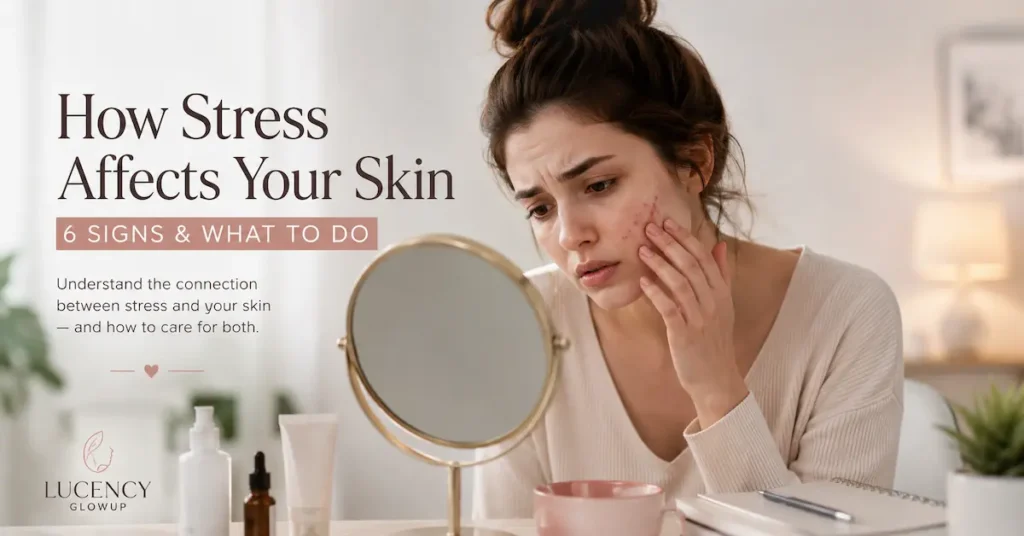
How Stress Affects Your Skin: 6 Signs & What to Do
By Nisa Qamar | Founder, Lucency GlowUp. 3+ years in skincare & wellness
You know the week. The one where your inbox won’t stop, your calendar is a wall of back-to-back blocks, and somewhere between Tuesday and Thursday, your skin just… gives up. A jaw breakout appears out of nowhere. Your face feels tight and dull no matter how much moisturizer you layer on. Maybe there’s a weird itchy patch on your neck you can’t explain.
You didn’t change your routine. You didn’t eat anything wild. So what’s going on?
Stress can affect your skin in more ways than you might expect. It can contribute to breakouts, dryness, redness, sensitivity, and flare-ups of certain skin conditions. When you’re under ongoing stress, your body’s stress response can influence hormones, inflammation, oil production, and your skin’s protective barrier.
This isn’t just a feeling, and it’s definitely not “just in your head.” There’s a real connection between your brain, nervous system, and skin. Once you understand how stress affects your skin, you can make a few simple changes to support your skin without adding another complicated routine to your already busy day.
Quick answer: Stress raises cortisol, which increases oil production, weakens your skin barrier, and ramps up inflammation — showing up as breakouts, dryness, redness, or flare-ups. The 6 most common signs are:
- Stress acne or breakouts
- Stress rash or hives
- Dullness and dryness
- Eczema, psoriasis, or rosacea flare-ups
- Dark circles or tired-looking skin
- More noticeable fine lines
Keep reading for what’s actually happening under the surface, plus a simple routine to manage it.
The Skin-Brain Connection: How Stress Affects Skin
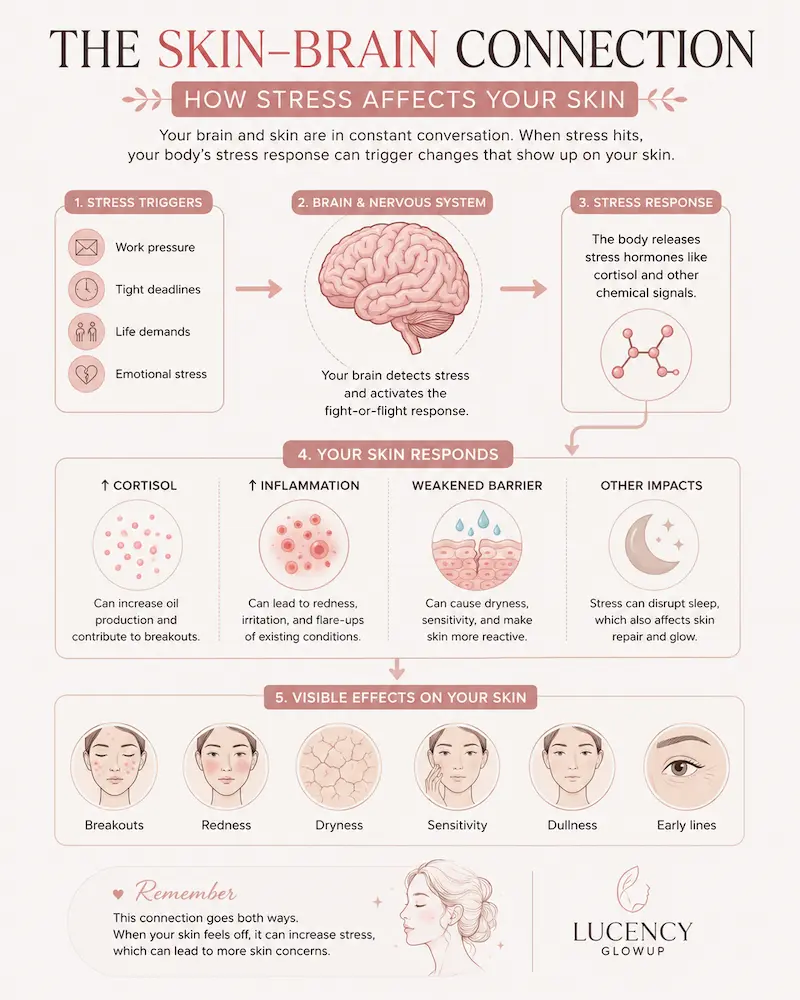
Your brain and your skin are in constant conversation, whether you notice it or not. When stress hits, that conversation gets loud.
Here’s the short version: stress triggers your body’s fight-or-flight response, which releases cortisol. Cortisol tells your skin to produce more oil, ramps up inflammation, and weakens your skin’s protective barrier. Add all that up, and you get breakouts, dryness, redness, or sensitivity — sometimes all in the same week.
This isn’t just a feeling, either. Dermatologists have studied this connection for years, and skin cells really do respond to stress hormones directly. Your skin isn’t just showing stress — it’s part of the reaction.
The reassuring part? Your skin isn’t broken, and your routine probably isn’t the problem. Your body is just doing what stressed bodies do. And research from Harvard Health confirms this connection runs both ways — a breakout can make you feel more stressed, which can bring on more breakouts. Naming that loop is often the first step to breaking it.
What Happens to Your Skin When You’re Stressed?
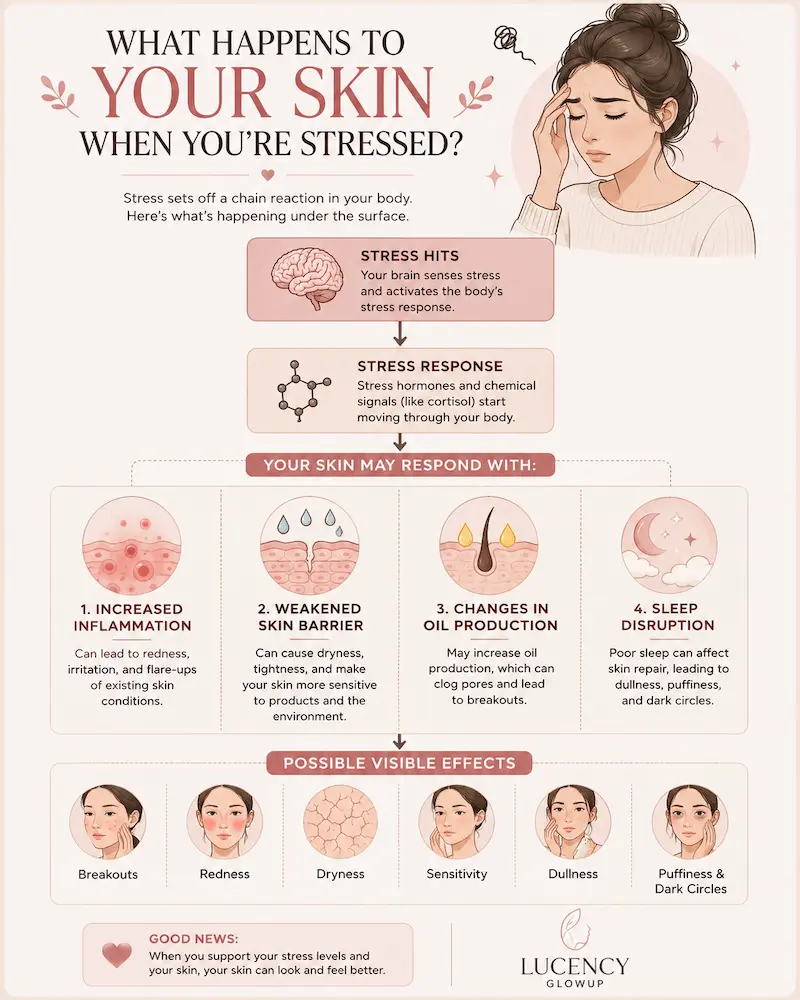
So, what is actually happening underneath the surface when you’re having one of those weeks?
Think of it as a chain reaction. When your brain senses stress, your body switches into survival mode. Stress hormones and other chemical signals start moving through your body, and your skin responds right along with them.
First, stress can increase inflammation. That can make your skin look redder, feel more sensitive, or make an existing skin problem more noticeable.
Then there’s your skin barrier — the protective layer that helps keep moisture in and irritants out. Ongoing stress can interfere with how well that barrier functions, which may leave your skin feeling dry, tight, or easily irritated.
Stress can also affect oil production. For some people, that extra oil can contribute to clogged pores and breakouts. And when stress starts messing with your sleep, your skin can look even more tired, dull, or puffy.
Cortisol is the hormone doing most of this work behind the scenes — but it isn’t the enemy, and one stressful afternoon won’t undo your skin overnight. It’s the pileup of stressful days that tends to show up on your face, especially once stress starts affecting your sleep and habits too. And because everyone’s skin responds a little differently, stress won’t necessarily hit you the same way it hits someone else.
6 Ways Stress Actually Shows Up on Your Skin
Stress doesn’t show up the same way for everyone. Here are the most common ways it affects skin, so you can connect the dots faster next time.
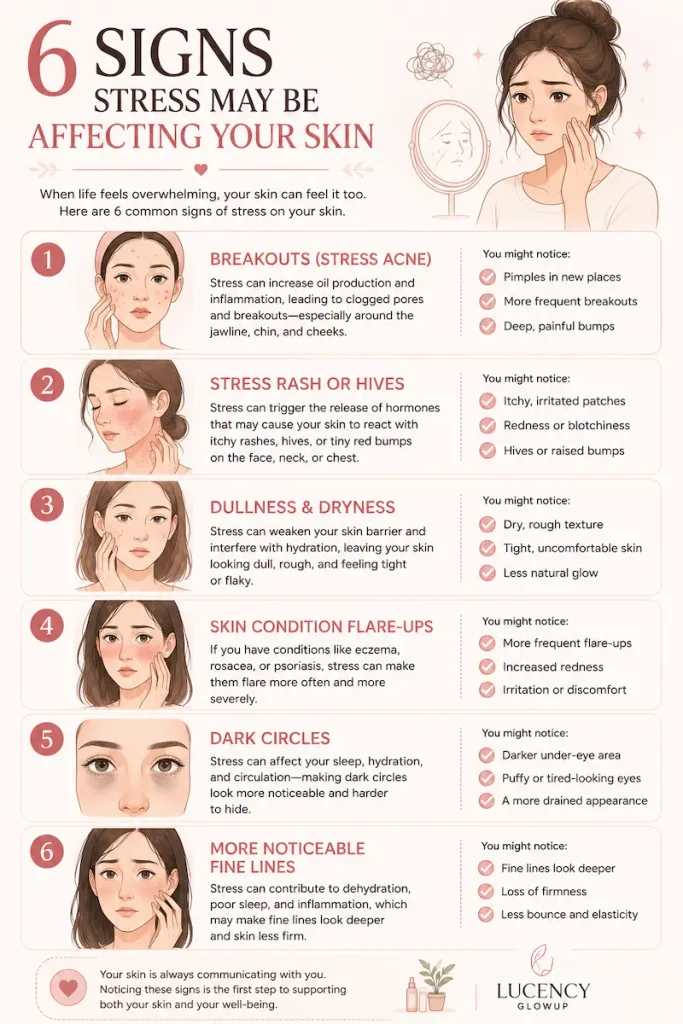
1. Stress acne or breakouts
Dermatologists note that oil production is directly tied to stress — higher cortisol means more active oil glands and more clogged pores. The American Academy of Dermatology confirms this too — board-certified dermatologists report that stress causes glands to produce more oil, which can worsen acne in people already prone to breakouts.
Stress can contribute to breakouts, and some people notice them around the chin and jawline, although acne can appear anywhere on the face — often right when you have somewhere important to be (rude, we know).
2. Stress rash or hives
Some people break out in itchy, red, raised bumps during high-stress stretches. This is your immune system reacting to stress hormones. Quick safety note: if you ever notice swelling in your lips or face, trouble breathing, or feel lightheaded along with a rash, treat that as an emergency and get care right away.
3. Dullness and dryness
When your skin barrier weakens, it holds onto less moisture. Skin can start to feel tight, look flat, or lose that bounce-back glow.
4. Flare-ups of eczema, psoriasis, or rosacea
If you already manage one of these conditions, stress is one of the most common triggers for a flare. It’s not you doing anything wrong — a peer-reviewed study found people with inflammatory skin conditions report significantly higher stress levels than those without, so this really is a well-documented pattern. The AAD confirms stress as a well-known trigger for both psoriasis and eczema flares, alongside the inflammatory-condition research above.
5. Dark circles or tired-looking skin
Stress can disrupt sleep, which may leave your skin looking more tired, dull, or puffy and poor sleep shows up under the eyes.
6. Fine lines looking more noticeable
Chronic stress can speed up the breakdown of collagen and elastin, the proteins that keep skin firm. Over time, that can make fine lines more visible. The American Academy of Dermatology notes that stress hormones break down collagen and elastin and interfere with skin’s natural rejuvenation, accelerating visible aging.
If most of these sound familiar, it might be time for more than a product swap. Our Beginner Skincare Routine is a good place to rebuild the basics without overcomplicating things.
How to Manage Stress-Related Skin, Without Adding More to Your Plate
Once you know how stress can affect your skin, the next step is keeping your routine simple. You don’t need a 10-step routine or a spa weekend — just a few low-effort habits that slot into the routine you already have.
Skin-First Fixes (2 Minutes or Less)
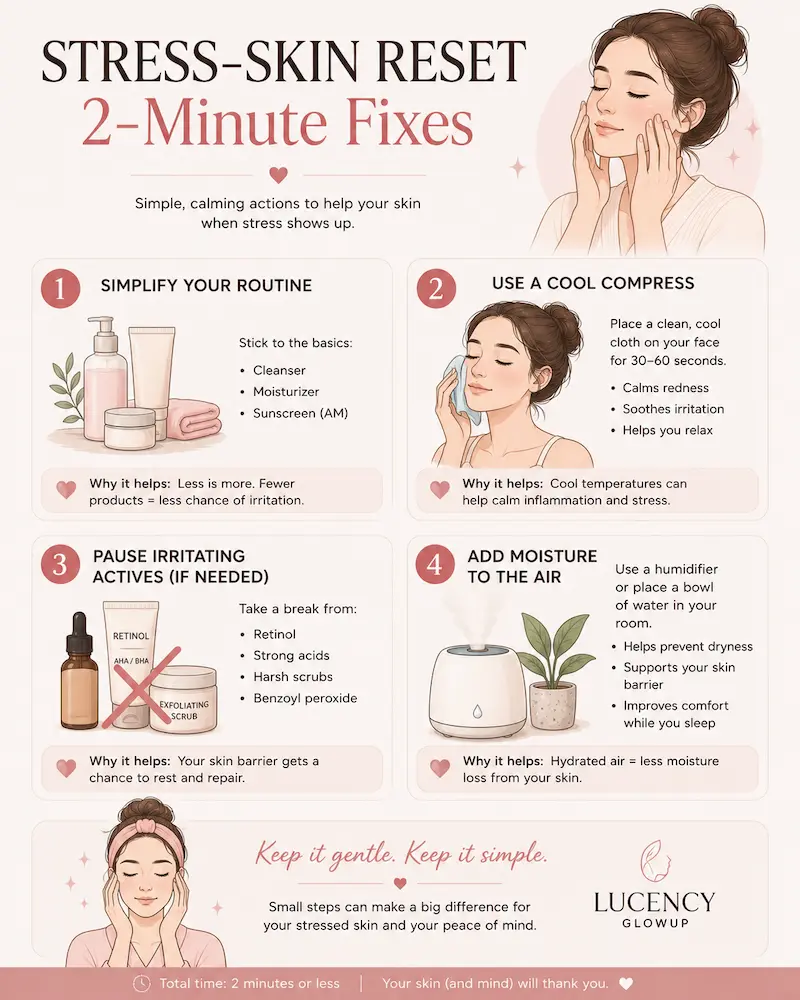
- Simplify instead of adding. During a stressful week, swap in a gentle, barrier-repairing moisturizer instead of piling on new products. Less can genuinely be more right now.
- Cool it down. Use a cool, clean compress for a few minutes to temporarily soothe redness or puffiness.
- Skip the actives temporarily. If your skin feels irritated, dry, or unusually sensitive, consider pausing new or potentially irritating actives until your skin feels comfortable again. Stick to fragrance-free, gentle cleansing in the meantime.
- Add moisture to the air, not just your face. A humidifier helps counter the dryness that stressed, cortisol-heavy skin tends to develop.
If you need a simple routine to fall back on during busy weeks, start with our Beginner Skincare Routine.
Micro Stress-Resets for Busy Schedules
You don’t have time for a 20-minute meditation, and honestly, neither do most of us. These take a fraction of that.
- Try 90 seconds of box breathing between meetings — in for 4, hold for 4, out for 4, hold for 4.
- Go phone-down during your skincare routine. Let those two minutes be a mini reset instead of another task to rush through.
- Build one wind-down cue into your night, like dimming the lights before bed or swapping your phone for five minutes of quiet.
- Give yourself a weekly reset instead of a daily overhaul. One slower, more intentional day goes further than trying to be “on” about stress management every single day.
If Sundays work better for you than daily rituals, our Sunday Glow Up Routine is built exactly for this — resetting your skin, space, and headspace before a new week starts.
When stress hits your skin, don’t:
- Scrub your face aggressively
- Wash repeatedly
- Pick pimples
- Introduce several new products at once
- Overuse exfoliating acids
- Panic-buy multiple skincare products
- Assume every rash is acne
- Ignore persistent or worsening symptoms
A Simple 5-Minute Routine
When stress is high, this isn’t the week to experiment with five new skincare products or force yourself into a perfect self-care routine.
Think simple, steady, and gentle.
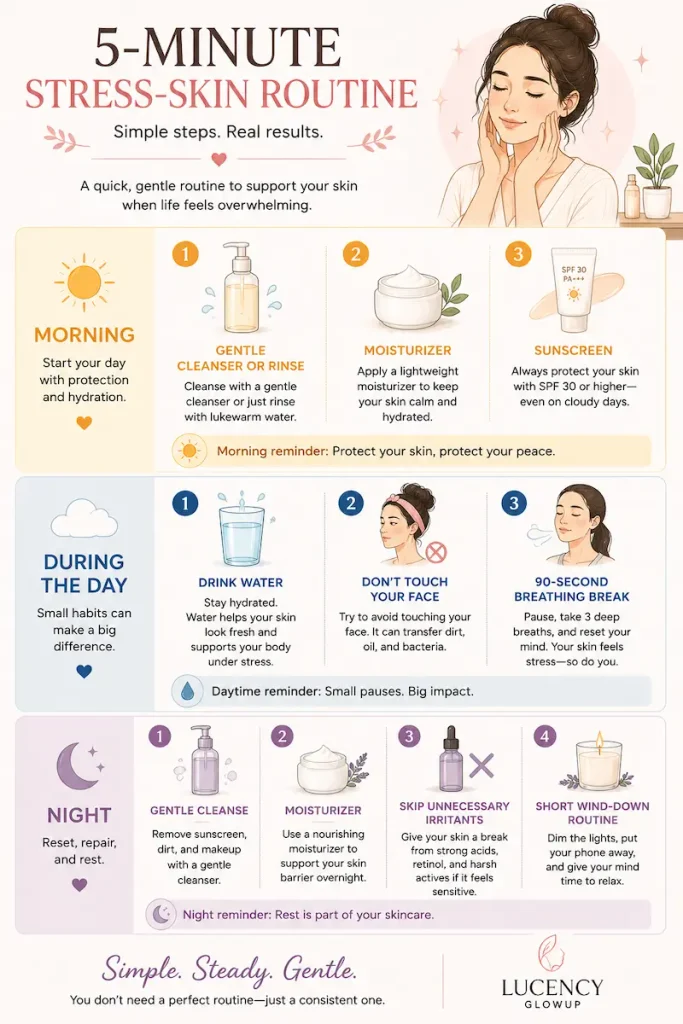
Morning
- Gentle cleanser or rinse
- Moisturizer
- Sunscreen
During the day
- Drink water regularly
- Avoid repeatedly touching your face
- Take a 90-second breathing break
Night
- Gentle cleanse
- Moisturizer
- Skip unnecessary irritating products if skin feels sensitive
- Start a short wind-down routine
You don’t have to fix your skin in one night. The goal is simply to stop adding stress to an already stressed routine. For one stressful week, let “good enough” be the goal.
Common Stress-Skin Mistakes and Myths to Avoid
A few things worth clearing up, since misinformation tends to make stress skin worse, not better. It’s easy to fall into these patterns when you’re exhausted and just want your skin to behave.
Myth: Stress skin means you need more products. Reality: during a flare-up, your barrier usually needs less interference, not more.
Mistake: Picking or touching your skin when you’re stressed. It’s a common habit under pressure, but it increases inflammation and can lead to scarring.
Myth: Stress breakouts mean your skin is dirty. Reality: this is hormonal, not hygiene-related. No amount of extra washing will fix a cortisol spike.
Mistake: Only treating symptoms on your face. Sleep, regular meals, hydration, and stress management can support your overall well-being, while a gentle skincare routine supports your skin directly.
When It Might Be More Than Stress
It’s easy to blame every sudden skin problem on a stressful week. But stress isn’t always the whole explanation.
Stress can contribute to breakouts, sensitivity, and flare-ups, but skin can also react to new products, allergies, medications, environmental changes, hormones, or an underlying skin condition. So if something doesn’t look or feel like your usual stress-related skin changes, don’t automatically assume stress is the cause.
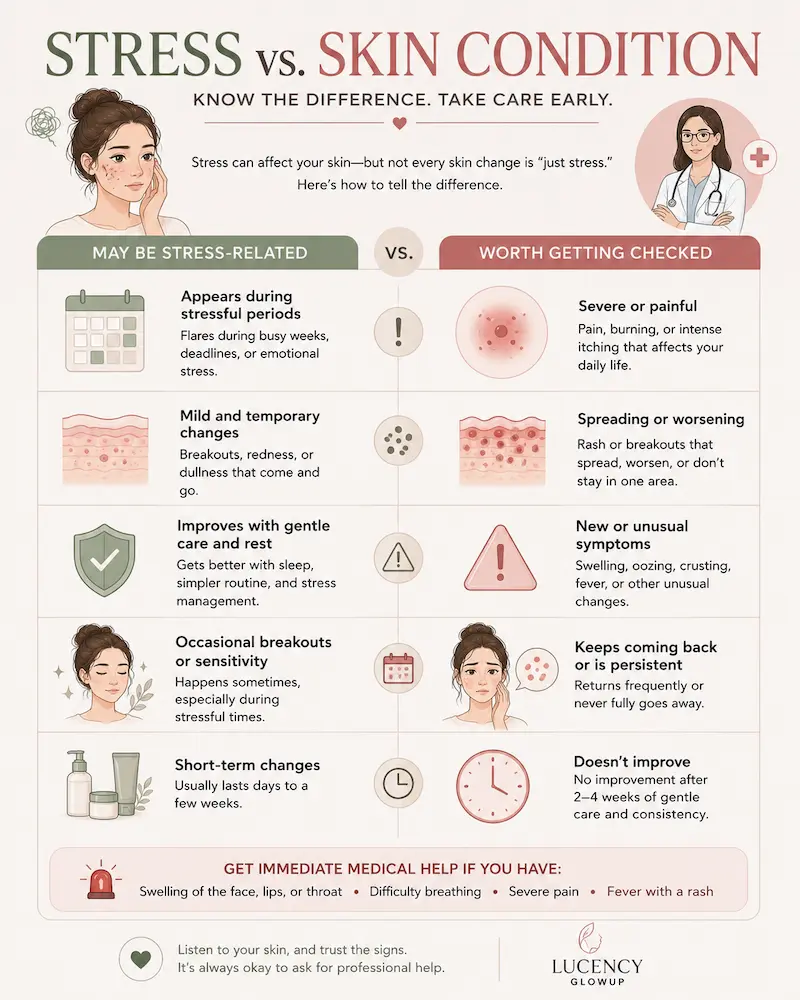
A few signs to pay attention to
- It’s severe or painful. A few occasional breakouts are different from painful, deep, or rapidly worsening skin changes.
- It’s spreading or getting worse. A rash that keeps spreading instead of settling deserves attention.
- The symptoms are new or unusual for you. If you’ve never experienced a particular type of rash, swelling, or irritation before, it’s worth finding out what’s causing it.
- It keeps coming back. Repeated flare-ups may point to an underlying condition or trigger that needs to be identified.
- Gentle care isn’t helping. If your skin isn’t improving after a couple of weeks of a simple, gentle routine, consider talking to a dermatologist.
And some symptoms shouldn’t wait. If a rash comes with swelling of your lips, tongue, or face, trouble breathing, or lightheadedness, seek emergency medical care.
The goal isn’t to worry about every breakout or dry patch. It’s simply to know the difference between giving stressed skin a little extra care and ignoring a problem that needs professional attention.
FAQ: Quick Answers About How Stress Affects Skin
Can stress really cause acne, or is that a myth?
It’s real. Stress can contribute to breakouts through changes in hormones, inflammation, and oil production. It can also make existing acne feel more difficult to manage. Stress isn’t the only cause of acne, though, so persistent or severe breakouts may need professional evaluation.
What does a stress rash look like?
Usually raised, red, itchy bumps or hives, often on the face, neck, chest, or arms. It can appear pretty suddenly during high-stress periods.
How long does it take for skin to clear up after stress goes down?
It varies, but many people notice improvement within a couple of weeks of lower stress and consistent, gentle care.
Can stress cause wrinkles or premature aging?
Over time, yes. Chronic stress can break down collagen and elastin, which can make fine lines more noticeable.
Why does my eczema, psoriasis, or rosacea flare up when I’m stressed?
These are inflammatory conditions, and stress hormones ramp up inflammation in the body. That’s often enough to trigger a flare.
What’s the fastest way to calm a stress breakout?
Simplify your routine, avoid picking, use a cold compress for redness, and give your skin a few days of gentle, minimal care.
When should I see a dermatologist instead of treating it myself?
If a rash or breakout is severe, painful, spreading, or not improving after a couple of weeks of gentle care, it’s worth getting it checked out.
Final Thoughts
Your skin isn’t working against you — it’s just telling you something. Once you understand how stress affects skin, it’s a lot easier to be gentle with yourself when a breakout or flare-up shows up.
You don’t need a complicated routine to feel like yourself again. Just a few realistic habits that support your skin and your nervous system at the same time. Ready to build those in without adding more to your plate? Start with our 30-Day Glow Up Challenge for Busy Women — it’s a simple, low-pressure place to begin.
Give your skin — and yourself — a little grace this week. You’re doing better than you think.
Disclaimer: This article is for general educational purposes and isn’t a substitute for professional medical advice, diagnosis, or treatment. If you have persistent, severe, painful, or worsening skin symptoms, consult a qualified dermatologist or healthcare professional.
About Author

NISA QAMAR
Nisa Qamar is the founder of Lucency GlowUp, where she shares practical skincare, wellness, and self-care tips for busy women. Her content focuses on building healthy habits that support confidence, balance, and long-term transformation. Nisa has spent 3+ years testing and refining these routines herself, and shares them as personal experience — always alongside, not in place of, advice from a dermatologist or doctor.
© Lucency GlowUp — All Rights Reserved